 Daily Logic Games
5 Daily Brain Exercises
That Are Better Than Sudoku
By Edward Kelly — Puzzle Designer & Creator of Daily Logic Games

We all love Sudoku. It is satisfying, logical, and incredibly orderly. But here is the uncomfortable truth: Sudoku only trains one specific type of thinking.
Cognitive scientists often compare brain training to physical exercise. If you go to the gym and only ever do bicep curls, you will develop fantastic arms, but you might throw out your back the next time you try to pick up a heavy box. Similarly, if you only play Sudoku, you become an absolute master of deductive grid logic, but you are neglecting arithmetic speed, pattern recognition, and lateral algebraic thinking.
To achieve true neuroplasticity, your brain demands novelty. It needs to be forced out of comfortable, familiar pathways and challenged with mechanics that break the rules it has already memorized.
Here are 5 daily exercises that provide a much more balanced cognitive diet, targeting the critical areas of the brain that Sudoku leaves behind.
1. Daily Equation (Logic + Arithmetic)
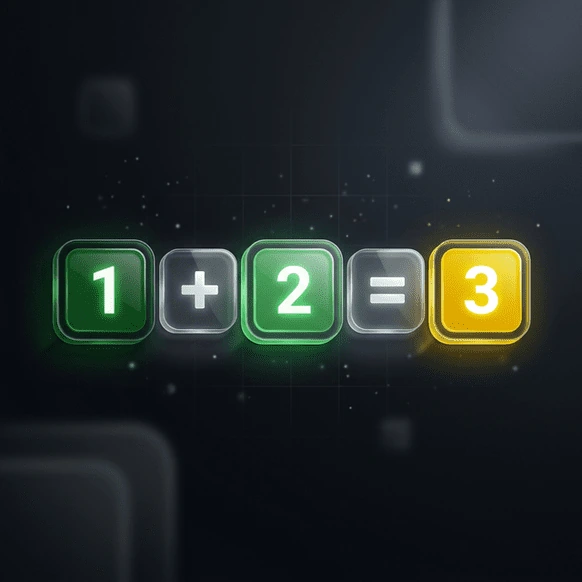
Imagine Wordle, but reconstructed for numbers. Instead of guessing a static 5-letter word, you
must guess a hidden mathematical equation (like 4+3*2=10) in six tries. Every guess
must mathematically balance.
Sudoku contains zero actual mathematics; you could easily replace the numbers 1 through 9 with nine different colors and the game would play exactly the same. Daily Equation forces your brain to rapidly switch between deductive placement (knowing the '+' sign must be in the second slot) and active mental math (calculating the outcome).
🧠 Cognitive Targets:
- Dual-Mode Processing: Forces the brain to alternate between symbolic logic and arithmetic calculation in milliseconds.
- Working Memory: You must remember which digits have been eliminated while constructing a valid formula.
Daily Equation
Can you guess the hidden mathematical formula in 6 tries?
PLAY NOW →2. Make 24 (Lateral Thinking)
In Make 24, you are presented with four numbers (for example: 4, 7, 8, 8). You must use addition, subtraction, multiplication, and division to combine those exact four numbers so that they equal 24.
Sudoku is highly linear. If you follow the rules perfectly, you are guaranteed to move forward. Make 24 shatters linear thinking. It requires lateral thinking—the ability to look at a problem from an unusual angle. You have to willingly break apart numbers, test bizarre fractional combinations, and embrace trial-and-error creativity to find the hidden path.
🧩 Cognitive Targets:
- Mental Flexibility: Overcoming the urge to only use simple addition or multiplication.
- Fractional Logic: Solving advanced hands often requires creating a fraction and multiplying it out.
3. Number Sequence (Inductive Reasoning)
A sequence puzzle presents you with a list of numbers and asks you to find the next logical entry. A basic example is "2, 4, 8, 16...", where the rule is simply multiplying by two. But advanced sequences ("1, 1, 2, 3, 5, 8...") require serious induction to unravel.
This game trains a completely different type of logic than Sudoku. Sudoku trains deductive logic (applying a known, static rule to a new situation). Sequences train inductive logic. You are given the outcome and you must act as a detective to discover the invisible rule governing it.
🔍 Cognitive Targets:
- Pattern Recognition: Training the eye to instantly spot mathematical relationships across sets of data.
- Hypothesis Testing: You must formulate a rule, test it against the sequence, and quickly pivot if it fails.
4. Calcudoku (Spatial Math)
Calcudoku (sometimes called Math Sudoku) takes the familiar Sudoku grid but fundamentally alters the rules of engagement. While it still forbids duplicate numbers in any row or column, it removes the 3x3 sub-grids entirely.
Instead, the board is divided into heavily outlined "cages." Each cage contains a target number and a mathematical operation (like "15×" or "3÷"). You must place digits inside that cage so that, when the operation is applied, they equal the target number. This brilliantly solves Sudoku's lack of arithmetic, forcing you to calculate factors and sums while simultaneously managing the grid's spatial constraints.
📐 Cognitive Targets:
- Constraint Satisfaction: Balancing the abstract rule of "no duplicates" with the rigid rule of mathematical accuracy.
- Factoring Speed: Rapidly recalling all possible factors of a number (e.g., knowing "12×" in a 3-cell cage could be 1, 3, 4 or 2, 2, 3 or 1, 2, 6).
5. Missing Digits (Algebraic Intuition)
In Missing Digits, you are presented with an incomplete equation containing empty blanks (for
example: _ 2 + 5 _ = 8 7). You are given a specific set of digits and must place
them into the correct blanks to make the equation true.
This exercise builds foundational "Number Sense." You stop seeing numbers as static, isolated symbols and start seeing the fluid relationships between them. You learn to instantly spot that a '5' plus a blank equaling '8' means the blank must be a '3'. It is essentially stealth algebra training, rewiring how you process basic math.
The Ideal Daily Routine
You do not need to spend hours training to reap the benefits. A highly effective, balanced 15-minute routine looks like this:
- Warm-up (3 mins): Play Missing Digits to activate rapid arithmetic and number sense.
- Heavy Lifting (7 mins): Play Calcudoku or Daily Equation to combine deep spatial logic with arithmetic execution.
- Cooldown (5 mins): Play Make 24 to stretch your lateral thinking and creativity.
The Verdict on Mental Fitness
Sudoku is an incredible puzzle, and there is no reason to remove it from your life if you enjoy it. But if your goal is comprehensive cognitive fitness, relying on a single game is a strategic mistake.
By introducing Daily Equation, Make 24, Sequences, Calcudoku, and Missing Digits into your rotation, you ensure that every part of your deductive, inductive, and arithmetic brain gets the workout it desperately needs.

Don't Just Train One Muscle
Get a full-brain workout with our daily rotation of logic, arithmetic, and pattern puzzles.
START WORKOUT →