 Daily Logic Games
The Math Behind Wordle:
Why Equation Puzzles Boost Logical Thinking
By Edward Kelly — Puzzle Designer & Creator of Daily Logic Games
When Wordle took over the world in 2021, it was hailed as the ultimate word game. But for those of us who prefer numbers to letters, a more challenging variant emerged: Equation Wordle (often called Nerdle).
On the surface, they look the same. You have 6 tries to guess a hidden sequence. You get Green, Yellow, and Gray clues. But mathematically, the Equation version is significantly deeper. Here is why.
1. The Constraint of "Truth"
In regular Wordle, you can guess any valid word. You can guess "PIZZA" even if you know the answer doesn't contain a Z, just to test other letters.
In Equation Wordle, every single guess must be mathematically true.
- You cannot guess
1+1=55. - You must balance the equation:
10+5=15.
This adds a massive cognitive load. You aren't just searching for characters that fit the visual pattern; you are constantly performing arithmetic to ensure your guess is valid. This is what scientists call "Dual N-Back" training—forcing your working memory to hold two different rule sets simultaneously.
2. The Commutative Problem
In English, "TEAM" and "MEAT" are totally different words. If the 'T' is green in the first slot, you know exactly where it goes.
In math, however, 3 + 4 = 7 and 4 + 3 = 7 are mathematically identical, but
positionally different.
The Trap:
You might guess 2 + 6 = 8. The game turns the '2' and '6' Yellow.
Now you have to deduce: Is the answer 6 + 2 = 8? Or is it something completely
different like 16 / 2 = 8? The logical tree branches much faster than in word
games.
3. The Best Starting Guess
In regular Wordle, everyone knows the best starting words: "ADIEU," "RAISE," or "CRANE." They maximize vowel coverage.
In Equation Wordle, the best strategy is maximizing unique digits and operators.
A mathematically optimal opening guess is:
9 * 8 - 7 = 65
Why? Because it tests:
- Five distinct numbers (5, 6, 7, 8, 9).
- Two different operators (Multiplication and Subtraction).
- The placement of the equals sign.
The Information Theory of Guesses
To truly master a constraint-based logic puzzle like Equation Wordle, one must look beyond simple arithmetic and into the realm of Information Theory. Developed by Claude Shannon in 1948, Information Theory provides a rigorous mathematical framework for quantifying the amount of "information" contained in a message—or in this case, a guess. At the heart of this theory is the concept of Information Entropy, measured in "bits."
In a game of hidden sequences, each potential answer exists within a finite "possibility space." At the start of a puzzle, the entropy is at its maximum because every valid mathematical equation is equally likely. Your objective as a player is not necessarily to find the correct answer on the first try, but to choose a guess that provides the maximum possible expected information, thereby reducing the entropy of the remaining possibility space as efficiently as possible.
What is a "Bit"?
Mathematically, a bit of information is defined as the amount of data needed to reduce the possibility space by half. If your guess eliminates 50% of all remaining valid equations, you have gained exactly 1 bit of information. A perfect opening guess in Equation Wordle often provides 4 to 5 bits, narrowing thousands of permutations down to a manageable handful.
The "rigor" of math-based puzzles comes from how these clues partition the possibility space. In word-based Wordle, the distribution of letters is dictated by linguistics and frequency. However, in Equation Wordle, the constraints are absolute and universal.
Linguistic Wordle
Guesses are limited by dictionary "validity" and relative letter frequency (e.g., E is more common than X).
Mathematical Wordle
Guesses are limited by Universal Truths. A "Gray" clue for '7' invalidates entire branches of arithmetic logic.
The partitioning power of a mathematical clue is often higher because the rules of arithmetic—such as the order of operations and the requirement of equality—are more restrictive than the rules of English spelling.
Pro Tip: Information Efficiency
By calculating the entropy of each potential guess, computers can determine the theoretically "optimal" move. For human players, this translates to avoiding guesses that "overlap" with known information.
🧠 If you know the answer must be even, guessing an odd result provides 0 bits of new information. Don't waste the turn!
Mastering the "Math Behind Wordle" means training your brain to think in terms of permutations and entropy-reduction rather than just trial and error.
Where Equation Wordle Came From
Nerdle — the most widely played Equation Wordle variant — was created in January 2022 by Richard Mann, a London-based data scientist, and his daughter Imogen during a car ride. The family had been watching the Wordle craze explode on social media and agreed that maths lovers deserved their own version. Within hours, childhood friend and developer Marcus Tettmar had built the game; Richard's son Alex handled the valid equation database. It launched quietly on 20 January 2022.
The growth was immediate and staggering. Within five days it was being played by 400 users per minute across 53 countries. By day 13 it had reached 360,000 daily players. Today the "nerdleverse" spans over 20 variants — Mini, Micro, Midi, Maxi, Speed, Instant, and more — and there are an estimated 17,723 valid 8-symbol equations in the Classic version's answer pool. Daily Logic Games' own Daily Equation follows the same core rules: every guess must be a valid, balanced equation, and you have six attempts to find the hidden one.
4 Practical Tactics to Solve Faster
Understanding the theory is one thing. Translating it into a lower guess count requires specific habits. These four tactics are used by experienced Equation Wordle players to consistently solve in three or four guesses.
1. Lock the Equals Sign First
The position of "=" tells you the length of the left side. If your opener places "=" in column 6 and it goes grey, the answer uses column 5 or 7 — eliminating a third of all valid structures instantly.
2. Prioritise Operators Over Digits
There are only four operators (+, −, ×, ÷). Confirming or eliminating them early is more efficient than testing individual digits. Use your first guess to include at least two different operators.
3. Respect Order of Operations
Every guess must follow PEMDAS/BODMAS — multiplication and division execute before addition and subtraction. A guess like 2+3*4=20 is invalid because 3×4=12, so 2+12=14, not 20. Invalid guesses are rejected entirely.
4. Never Waste a Guess on Known Info
If a grey tile confirmed that "7" is not in the equation, don't use 7 again. If you know the result is even, don't guess an odd result. Every repeat of known information is a wasted turn — zero new bits gained.
🟢 How to Read the Colour Feedback
- GREEN: Correct symbol, correct position. Lock it in — do not move it in future guesses.
- PURPLE (or YELLOW): Symbol is in the equation but in the wrong position. Move it — don't drop it.
- GREY: Symbol does not appear in the equation at all. Eliminate it from every future guess.
Conclusion
If you find Equation Wordle harder than the original, don't worry. It is harder. It requires more active processing power. But that also means it's a better workout for your logical reasoning skills.
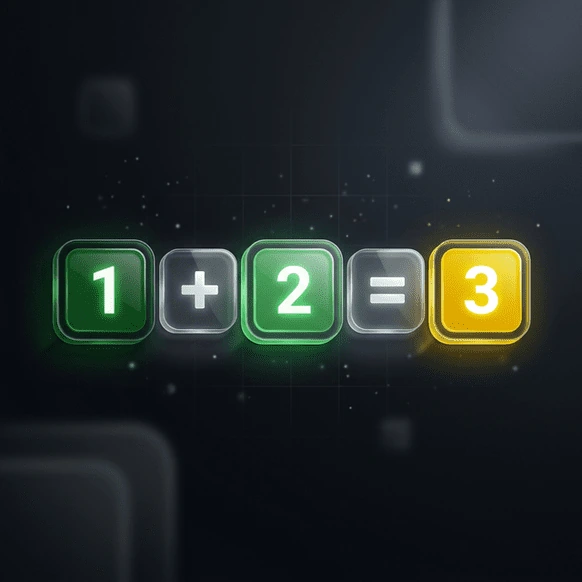
Master the Equation
Can you solve today's equation in fewer than 4 guesses?
PLAY NOW →