 Daily Logic Games

🧠 TL;DR: Calcudoku vs. Sudoku
- Sudoku: Pure spatial logic. Numbers function solely as symbols to fill a Latin square.
- Calcudoku: Spatial logic + arithmetic. Numbers must fill a Latin square AND mathematically resolve targeted equations within localized cages.
Calcudoku is a puzzle game that combines Sudoku-style grid logic with basic math. Instead of just placing numbers, you also have to solve simple math problems to figure out where each number belongs. It is a fun and challenging way to test your brain.
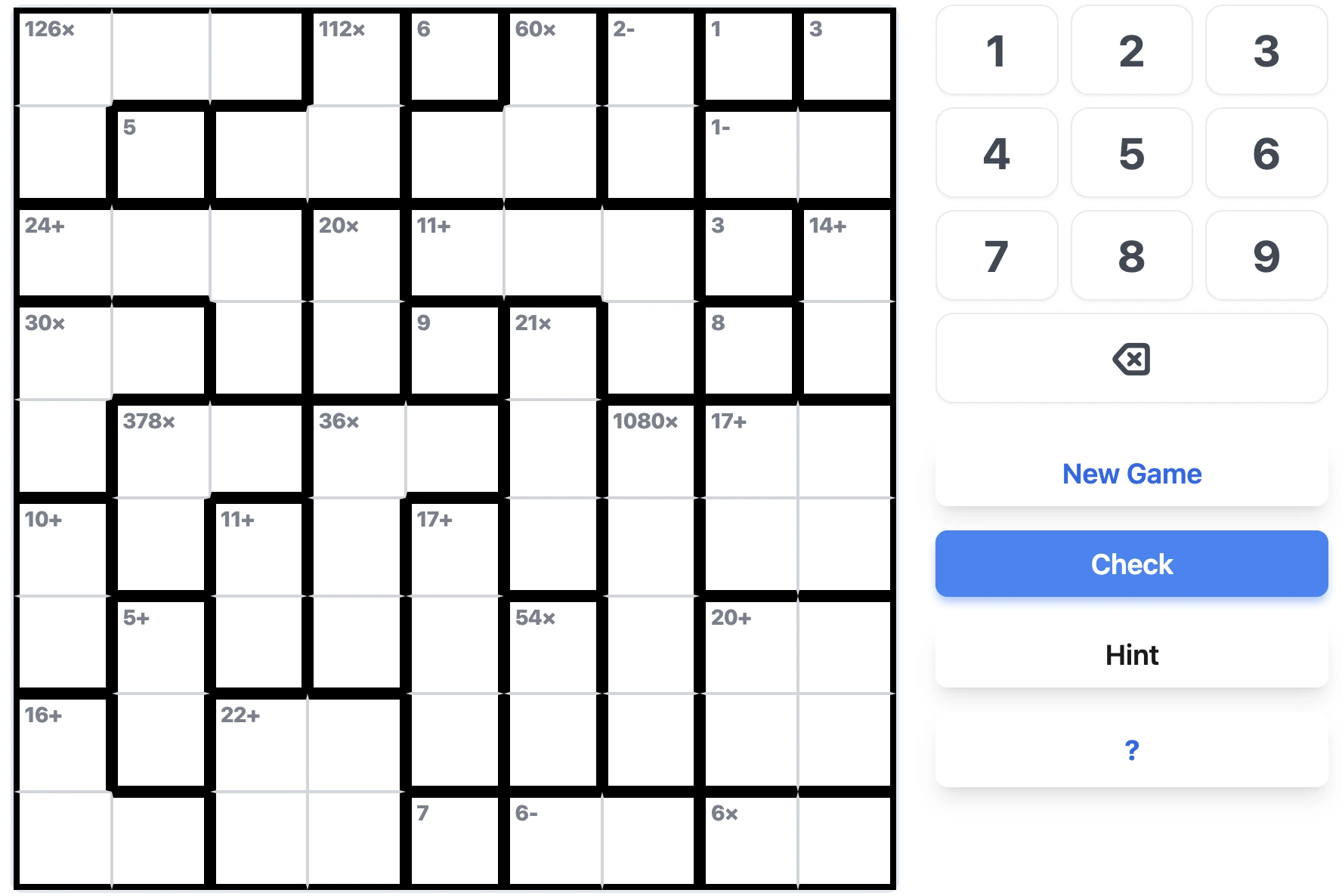
Just like in a Latin square, no number can repeat in any row or column. The grid is also divided into heavily outlined shapes called cages, which each have a target number and a math symbol. The numbers you put inside a cage must equal that target number when you add, subtract, multiply, or divide them.
This mathematical constraint dictates that solvers must not only determine where a number belongs spatially, but also whether its inclusion satisfies the algebraic requirements of its immediate cluster. Consequently, the game forces the human brain to oscillate continuously between logic-based elimination and computational arithmetic. Mastery of Calcudoku is not merely an exercise in pattern recognition; it is a test of computational endurance and logical deduction operating under inflexible, intersecting parameters.
The Origins of Math Sudoku
The architectural foundations of Calcudoku trace their origins to 2004, when Japanese mathematics educator Tetsuya Miyamoto invented KenKen. Miyamoto developed the puzzle not as an entertainment product, but as a pedagogical instrument designed to enforce computational fluency and logical rigor in his students. His instructional philosophy rejected rote memorization in favor of self-directed deduction, positing that students learn best through the struggle of unguided problem-solving.
- 2004 Invention: Engineered to be entirely language-independent, relying strictly on universal mathematical notation.
- Classroom Origins: Rapidly expanded beyond the classroom, achieving international commercial success and syndication in major publications worldwide.
- Name Evolution: Calcudoku emerged as a direct evolution of Miyamoto’s original design to avoid trademark restrictions. Over the following two decades, the format splintered into numerous naming conventions (MathDoku, Kendoku, KenDoku), yet the underlying algorithmic constraints remained identical.
The evolution of Calcudoku reflects a broader shift in logic puzzles, transitioning from purely spatial challenges to hybrid models that demand multi-domain cognitive processing. Today, Calcudoku serves as both a tool for cognitive preservation and a rigorous test of analytical capacity for advanced solvers.
The Rules of Calcudoku Explained
Rule 1: Spatial PlacementThe structural integrity of a Calcudoku puzzle relies on two inflexible rule sets operating in tandem. The first rule set dictates spatial placement: the puzzle is played on an N × N grid, and every row and every column must contain exactly one instance of the digits 1 through N. This is the definition of a Latin square. Repetition of any digit within a single row or column renders the entire solution invalid.
Rule 2: Mathematical CagesThe second rule set governs mathematical equivalence within localized boundaries. The grid is segmented into distinct cages, marked by thick black borders. Each cage displays a target number in its upper-left corner, typically followed by a mathematical operator (+, -, ×, ÷). The digits placed inside the cells of a cage must combine, using the specified operation, to equal the target number.
Crucially, the order of operations within a cage does not matter; for subtraction and division cages, the target is achieved by subtracting or dividing the smaller numbers from the largest number in the cage. Digits may repeat within a single cage, provided they do not violate the primary spatial rule prohibiting repetition. In cages containing only a single cell, the target number is the exact digit that must be placed in that cell. A solver must satisfy both the spatial constraints and the localized mathematical constraints simultaneously to achieve the single, valid solution.
Grid Sizes and Number Constraints
The dimensions of a Calcudoku grid fundamentally dictate the available number pool and the ensuing computational complexity. An N × N grid strictly limits the permissible digits to the range of 1 through N. For example, a 4x4 grid utilizes only the digits 1, 2, 3, and 4. A 6x6 grid requires the digits 1 through 6, and a 9x9 grid demands the digits 1 through 9. This constraint has profound implications for mathematical deduction.
As the grid size increases, the number of possible permutations for any given mathematical cage expands exponentially. In a 4x4 grid, a cage demanding a product of 12 can only be satisfied by the digits 3 and 4 (if a two-cell cage) or 1, 3, and 4 (if a three-cell cage). However, in a 6x6 grid, a product of 12 introduces additional valid combinations, such as 2 and 6. The expansion of the number pool therefore forces the solver to evaluate a wider array of candidate digits and employ deeper layers of deductive logic.
💡 Mathematical Constant: The Sum Rule
The total sum of any single row or column is a fixed constant determined by the grid size, calculated using the formula N(N+1)/2. For a 4x4 grid, the sum of each row is 10. For a 6x6 grid, the sum is 21. For a 9x9 grid, the sum is 45. Advanced solving strategies critically depend on these fixed constants, allowing solvers to deduce the contents of specific cages by analyzing the aggregate sum of an entire row or column.
Understanding the inflexible boundaries established by grid size is the prerequisite for mastering advanced Calcudoku logic.
Understanding Mathematical Cages
The Core MechanicMathematical cages form the internal skeletal structure of a Calcudoku puzzle, imposing localized arithmetic constraints that interface with the global spatial rules. A cage is defined by a heavy border enclosing one or more contiguous cells. The top-left corner of the cage displays a target number and an operator (+, -, ×, ÷). The core mechanic requires that the digits entered into the cage's cells yield the target number when the specified operator is applied to them.
Different mathematical operations govern cages under specific rules:
- Addition (+) and Multiplication (×): These operations are commutative. The order in which the numbers are processed is irrelevant. A three-cell addition cage with a target of 12 could be satisfied by the sequence 3, 4, 5 in any configuration.
- Subtraction (-) and Division (÷): These cages are almost exclusively limited to two cells. The operation is applied by subtracting the smaller digit from the larger digit, or dividing the larger digit by the smaller digit, regardless of their spatial order within the cage. For example, a '3÷' cage could contain 1 and 3 (valid in any grid), or 2 and 6 (valid in a 6×6 grid or larger).
- Single-Cell Cages: If a cage lacks an operator and contains only a target number, that exact digit must be placed directly into the cell. These serve as absolute mathematical axioms.
The interplay between adjacent cages is the primary engine of puzzle resolution. A deduction made in one cage inherently limits the available digits for intersecting cages, triggering a chain reaction of logic that systematically reduces the possibility space. The solver must continuously evaluate the intersection of cage boundaries with row and column boundaries, isolating cells where only a single digit satisfies both sets of intersecting constraints.
Best Strategies to Solve Calcudoku Puzzles
Mastery of Calcudoku requires the abandonment of intuition in favor of rigorous, systematic deduction. The puzzle is entirely deterministic; every valid grid possesses exactly one mathematical solution.
Advanced solvers do not guess; they execute a series of algebraic eliminations until only the necessary digits remain. Below are the foundational strategies required to dismantle complex grids without resorting to trial and error.
The Single-Square Cage Strategy
The single-square cage is the absolute axiom of any Calcudoku puzzle. Because these cages lack an operator and consist of only one cell, the target number displayed must be written directly into that cell.
These are the fixed constants from which all subsequent logic cascades. Solvers must scan the grid immediately upon initiation and fill every single-square cage.
Once these anchors are established, their digits are instantly eliminated as candidates for all other cells occupying the same intersecting row and column, thereby fracturing the possibility space of adjacent, more complex cages.
Isolating Large Multiplication Cages
Multiplication cages targeting large products offer immediate structural vulnerabilities through prime factorization. When confronted with a high-value multiplication target, the solver must identify its unique factor pairs.
For example, in a 5x5 grid, a two-cell cage with a target of '20×' can only be satisfied by the digits 4 and 5. Because 20 cannot be reached by multiplying any other available digits (such as 1×20 or 2×10, which exceed the 1-5 parameter), the solver immediately knows those two cells must contain 4 and 5.
While their exact spatial order within the cage remains undetermined until intersecting constraints are analyzed, their presence instantly eliminates 4 and 5 from the rest of that row and column.
The Parity and Sum Rule
The Parity and Sum Rule is an advanced algebraic technique that exploits the fixed mathematical constants inherent to Latin squares. Because every row and column must contain the digits 1 through N exactly once, the aggregate sum of any row or column is always N(N+1)/2.
For a 6x6 grid, the sum of any single row is exactly 21. If a solver observes that five of the six cells in a specific row are enclosed within a single addition cage with a target of 18, they can subtract 18 from the fixed constant of 21.
The mathematical certainty is that the sixth, unenclosed cell in that row must contain the digit 3. This technique scales to cross multiple rows and columns, allowing experts to algebraically deduce hidden values by subtracting the sum of known cages from the immutable totals of the grid dimensions.
Common Mistakes to Avoid
Failure in Calcudoku is rarely the result of a mathematical error; it is almost universally caused by a procedural breakdown in logic. Solvers who fail to respect the deterministic constraints of the grid will inevitably create unresolvable paradoxes in the later stages of the puzzle.
Guessing vs. Deductive Logic
⚠️ Critical Error: The Bifurcation Trap
The most catastrophic procedural error a solver can make is bifurcation—the act of guessing. Calcudoku is not a game of probability. Entering a digit based on assumption rather than proof infects the entire grid with an unverified variable.
Because every cage and column interacts, a single false digit will cascade throughout the board, inevitably resulting in a collision of duplicate numbers or a mathematical impossibility.
By the time the paradox is discovered, identifying the original false assumption is nearly impossible, often requiring the solver to erase the entire board. Every digit placed must be mathematically proven as the only remaining possibility for that specific coordinate.
Where to Play Calcudoku Online Free
The digital landscape offers a robust array of platforms engineered for rigorous logical testing. For solvers seeking to apply the strategies detailed above, the following five resources represent the optimal environments for free, browser-based Calcudoku.
-
Daily Logic Games ★ Our Top Pick
Dive directly into our own Daily Calcudoku Challenge. We provide a clean, responsive interface perfect for testing daily permutations across standard grid sizes.
-
KenKen Puzzle (Official)
The trademark holder operates a massive repository at KenKenPuzzle.com, offering authorized daily challenges with extensive customization parameters.
-
Puzzle Baron's Calcudoku
Designed for the competitive analyst, this platform features thousands of unique grids alongside deep statistical tracking and global leaderboards.
-
Web Newdoku
A specialized platform that caters to extremists, providing non-standard grid sizes and the critical ability to export grids to PDF for analog, pencil-and-paper solving.
-
Sudoku Online Puzzles
A highly customizable web version of the game. This platform offers 100% free puzzles with multiple grid sizes, four difficulty levels, and helpful tools like pencil marks and a timer.