 Daily Logic Games

Futoshiki, which translates from Japanese as "not equal" or "inequality," is a rigorous logical deduction puzzle. It combines the strict spatial constraints of a Latin square with relative relational constraints dictated by mathematical inequality symbols.
🧠 TL;DR: Futoshiki vs. Sudoku
- Sudoku: Pure spatial logic based exclusively on absolute placement and elimination.
- Futoshiki: Spatial logic augmented by relational inequality constraints that dictate the relative magnitude between adjacent cells.
What is Futoshiki? Rules and Mechanics
The architectural foundation of any Futoshiki puzzle relies on the absolute law of the Latin square. On an N × N grid, every row and every column must contain exactly one instance of the digits 1 through N. No digit may repeat within a single axis.
The 'Not Equal' Philosophy
Futoshiki completely discards the rigid mathematical operations that define Calcudoku or Killer Sudoku. Instead of requiring solvers to calculate sums, products, or quotients, it demands pure relational analysis. You are no longer asking "what numbers add up to 12," but rather "what numbers can legally exist in this space given the hierarchical constraints of their neighbors."
- Absolute vs Relative: The shift from absolute calculation to relative magnitude forces a radical change in deductive reasoning.
- Directional Force: Every symbol acts as a directional force, pushing the possible values of a cell either toward the absolute minimum (1) or the absolute maximum (N). A cell is entirely defined by its boundaries.
⚖️ Relational Dependency
Unlike equality-based logic where numbers are isolated constants, Futoshiki numbers are fluid potentials until locked by their boundaries. A digit's identity is entirely dependent on its relationship to adjacent cells.
By stripping away arithmetic, Futoshiki distills logical deduction to its most fundamental state: inequality. Solvers must trace lines of hierarchical dominance across the grid, identifying where these forces intersect to create mathematically unavoidable conclusions. It is an exercise in bounding limits.
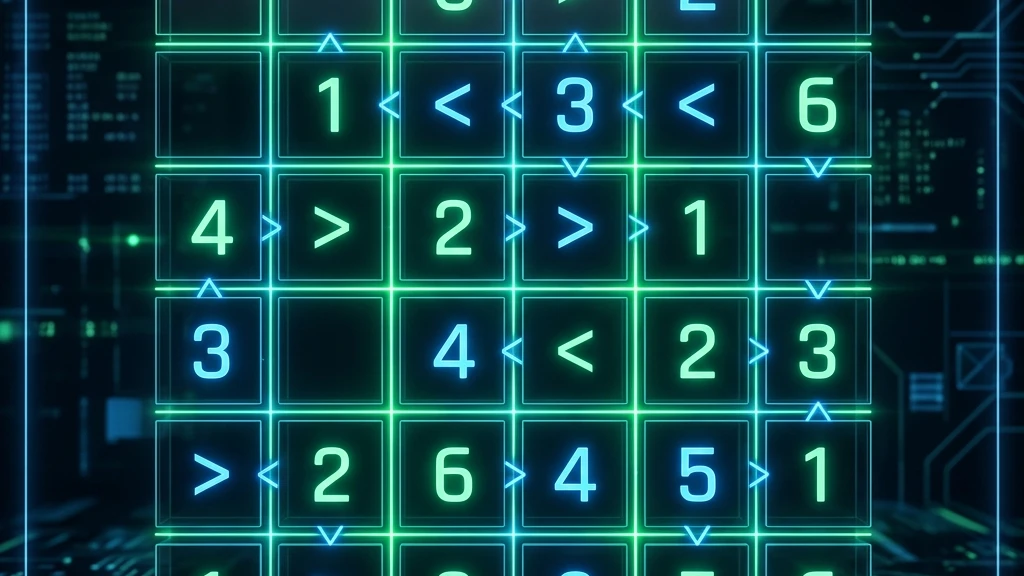
Understanding the Inequality Signs
The defining characteristic of Futoshiki is the presence of greater-than (>) and less-than (<) symbols wedged between adjacent cells. These symbols form rigid mathematical axioms. If a cell contains a 3 and is followed by a > symbol, the adjacent cell is mathematically restricted to the digits 1 or 2.
- Chaining A > B > C: When inequality symbols form a continuous chain, they establish strict boundaries for the minimum and maximum potential values within the sequence.
- Maximum Value Restriction: In a sequence of three descending cells, the final cell (C) cannot possibly be the grid's two highest numbers, while the first cell (A) cannot be the grid's two lowest numbers.
Playing Futoshiki 6x6 vs Standard Grids
The dimensions of the grid dictate the available number pool and the subsequent complexity of deductions. A 6x6 grid requires the digits 1 through 6, exponentially increasing the potential permutations for any given cell compared to a standard 4x4 or 5x5 matrix.
- Exponential Detonation: The leap from a 4x4 training grid to a 6x6 competition grid is not linear; it represents an explosive expansion of the mathematical possibility space.
- Vast Potential Values: While a single greater-than constraint in a 4x4 matrix slashes candidate pools, that same constraint in a 6x6 grid requires secondary and tertiary intersecting logic to resolve.
This combinatorial explosion demands that solvers abandon simple localized deductions. You can no longer look at a single interaction in a vacuum. A 6x6 matrix requires the solver to hold multiple, overlapping inequality chains in working memory, cross-referencing them against the macro-level Latin square constraints spanning the entire row and column.
💡 Strategic Axiom: Edge Case Elimination
Any cell with a greater-than symbol (>) pointing away from it must be larger than its neighbor, meaning it can never contain the digit 1. Conversely, any cell with an inequality symbol pointing toward it must be smaller than its neighbor, meaning it can never contain the grid's maximum absolute value (e.g., a 6 in a 6x6 grid).
Advanced Futoshiki Puzzle Strategies
To conquer high-level Futoshiki grids, intuition must be entirely replaced by systematic, deterministic logic. Every placement must be backed by an absolute mathematical proof of necessity. Below, we detail the foundational mechanics of advanced deduction, beginning with subset elimination.
- Algorithmic Pathways: These strategies are not mere suggestions; they are the required deterministic pathways to resolve complex matrices.
- Logical Integrity: Without mastering these techniques, solvers will inevitably fall into the catastrophic trap of bifurcation (guessing), which instantly invalidates the puzzle.
The AB Elimination Technique
The AB Elimination Technique—formally known as disjoint subset analysis or naked pairs—is the most potent tool for collapsing candidate pools across an entire axis. It exploits the inflexible Latin square law: if $K$ specific numbers are mathematically restricted to exactly $K$ specific cells within a given row or column, those numbers cannot exist anywhere else in that axis.
Consider a hypothetical 5x5 grid. You are analyzing Row 1 (R1). Through initial edge-case elimination, you have deduced that cell R1C1 and cell R1C2 can only possibly contain the digits 1 or 2. Perhaps they are bound by intersecting inequality chains from the columns above them, preventing them from being 3, 4, or 5.
🔍 The Locked Subset
Because R1C1 and R1C2 are locked into the candidate pool of {1, 2}, it is a mathematical certainty that one of these cells will be the 1, and the other will be the 2. The exact spatial arrangement is irrelevant at this stage of deduction.
This realization triggers a massive cascading elimination across the remainder of the axis. Because the digits 1 and 2 are guaranteed to occupy the first two cells of Row 1, they are simultaneously eradicated from the candidate pools of R1C3, R1C4, and R1C5. Those remaining three cells are now strictly limited to the candidates {3, 4, 5}.
This technique often reveals hidden placements that were previously obscured by excessive "noise" in the candidate data. For example, if R1C5 was previously evaluating the candidates {2, 3, 4}, the AB elimination of the 2 instantly reduces its possibilities. If another intersecting column constraint eliminates the 4, R1C5 is suddenly proven to be a 3.
- Identify the Pair: Scan rows and columns for two cells that share the exact same two remaining candidates.
- Lock the Axis: Mentally cordon off those two cells. Assume the two digits are placed.
- Execute Elimination: Delete those two candidate digits from every other cell intersecting that row or column.
The power of AB elimination lies in its scalability. Advanced solvers apply this logic not just to pairs, but to triplets (ABC elimination) and quads (ABCD elimination). If three cells in a column share the candidates {1, 2, 3}, those three numbers are wiped from the rest of the column. Recognizing these locked subsets is the primary differentiator between novice guessers and master analysts.
Furthermore, this technique operates independently of the inequality symbols. It relies purely on the structural constraints of the Latin square. By running AB elimination passes between inequality checks, solvers create an alternating rhythm of deduction: structural eliminations feed relational eliminations, which in turn feed structural eliminations, driving the grid toward its inevitable, singular conclusion.
Chaining Greater-Than Symbols: Min-Max Bounding
While isolated inequality symbols provide basic edge-case eliminations, continuous chains of symbols offer the most explosive deductive leverage in the game. This strategy is known as Min-Max Bounding, or range propagation. When symbols link three or more cells together, they establish absolute theoretical ceilings and floors for every cell caught within the sequence.
Consider a highly restrictive scenario in a 5x5 matrix. You encounter a continuous vertical column segment where four cells are linked by descending inequality symbols: A > B > C > D. The rigid hierarchy of this chain instantly shatters the candidate pools for all four involved cells, long before any cross-referencing row logic is even considered.
⛓️ The Squeeze Effect
A sequence of length $L$ requires $L$ distinct, sequenced numbers. This structural demand instantly eliminates the lowest $L-1$ numbers from the top of the chain, and the highest $L-1$ numbers from the bottom of the chain.
Applying Min-Max Bounding to our A > B > C > D chain in a 5x5 grid yields absolute mathematical boundaries:
- Cell A (The Apex): Because A must be strictly greater than three other distinct cells, it cannot possibly be 1, 2, or 3. The absolute minimum value for A is 4. Therefore, its candidate pool is instantly reduced to {4, 5}.
- Cell D (The Floor): Conversely, D must be strictly less than three other distinct cells. It cannot possibly be 3, 4, or 5. The absolute maximum value for D is 2. Its candidate pool is instantly reduced to {1, 2}.
- Cell B (Upper Mid): B must be less than A but greater than two distinct cells (C and D). It cannot be 1 or 2, and it cannot be 5. Its candidate pool is squeezed into {3, 4}.
- Cell C (Lower Mid): C must be less than two cells (A and B) but greater than D. It cannot be 4 or 5, and it cannot be 1. Its candidate pool is compressed into {2, 3}.
This single visual observation—identifying the length of the chain—has mathematically eradicated 12 false candidates across four cells in a matter of seconds. If any intersecting row contains a given number (for instance, if Row A already contains a 5), Cell A is instantly forced to be a 4, which subsequently forces B to be a 3, C to be a 2, and D to be a 1.
- Structural Fault Lines: Master analysts actively scan the grid for long chains before analyzing anything else, mapping the theoretical minimums and maximums.
- Skeletal Framework: Once these bounds are drawn, the solver creates a tightly constrained framework where the remaining structural logic easily collapses the puzzle.
The Forced Pairing Constraint
Beyond directional chains, converging symbols present another highly restrictive scenario. The Forced Pairing Constraint occurs when two identical inequality symbols point toward a single, central cell. A classic example is a sequence where Cell A is greater than Cell B, and Cell C is also greater than Cell B (A > B < C). This formation dictates that the central cell is the strict minimum among the three.
If Cells A, B, and C are collinear (in the exact same row or column), Cell B must be mathematically smaller than two distinct numbers. In this linear sequence within a 6x6 grid, Cell B cannot possibly be a 6, nor can it be a 5, because A and C must occupy the 5 and 6. However, if this constraint happens at a corner (orthogonal), A and C are in different axes and can both be 6, meaning B can still be 5.
- Maximum Constraint: When a cell has two "less-than" symbols pointing toward it, its candidate pool is compressed downward, eliminating the top two absolute digits of the grid.
- Minimum Constraint: Conversely, if a cell is forced to be greater than two adjacent cells (A < B > C), its candidate pool is compressed upward, eliminating the bottom two digits (1 and 2).
Identifying these forced pairings is crucial in the mid-game. Often, eliminating these extreme high or low digits from the central cell's candidate pool will trigger a cascading AB elimination across the entire row, allowing the solver to place numbers that initially seemed hopelessly ambiguous.
Common Procedural Mistakes in Futoshiki
⚠️ Critical Error: The Bifurcation Trap
The single most catastrophic mistake a solver can make is bifurcation—the act of arbitrarily guessing between two remaining candidates when the immediate logic is not apparent. Futoshiki is a deterministic matrix; every placement must be a mathematical certainty derived from existing constraints.
Guessing invalidates the logical integrity of the entire grid. If you guess wrong, the error may not manifest until the very end of the solve, at which point it is completely untraceable. If you reach an impasse, do not guess. Instead, meticulously re-scan the board for missed AB eliminations or Min-Max bounds. If you have guessed, the board is structurally compromised and requires a complete restart.
Where to Play Daily Futoshiki Online
The transition from theoretical strategy to practical execution requires a platform engineered for rigorous logical testing. While numerous generic puzzle aggregators exist across the digital landscape, serious analysts require a dedicated environment that respects the deterministic purity of the game.
For solvers seeking to apply AB Elimination and Min-Max Bounding on perfectly calibrated matrices, Daily Logic Games represents the premier destination for browser-based Futoshiki. The platform eschews cluttered interfaces and intrusive advertising in favor of a spartan, responsive UI designed entirely around cognitive focus.
🏆 The Daily Challenge Standard
Daily Logic Games specializes in the 6x6 competition standard. Every daily puzzle is algorithmically vetted to ensure exactly one unique solution, preventing the catastrophic design flaws found on lesser platforms.
Beyond the pristine grid generation, the platform integrates critical meta-mechanics designed to foster long-term cognitive discipline. The integrated Streak System tracks consecutive days of successful solving, quantifying your consistency and transforming a casual habit into a rigorous daily regimen. A visible fire icon and streak counter maintain accountability.
Furthermore, the persistent XP and Leveling architecture rewards complex deductions. Successfully breaking a 6x6 matrix yields experience points that progressively elevate your global rank. This gamification layer provides tangible metrics for your logical evolution, proving that your mastery of inequality chains and subset eliminations is quantifiably expanding over time.
- Zero-Friction Interface: Instant, browser-based access with zero registration barriers or paywalls.
- Dark Mode Optimization: Beautiful, high-contrast dark themes engineered to reduce ocular fatigue during intense analytical sessions.
- Cross-Platform Syncing: Seamless responsiveness ensures that a puzzle started on a desktop can be flawlessly completed on a mobile device.
Do not dilute your analytical training on sub-standard grids. Execute your strategies where the logic is pure. Navigate to the Daily Futoshiki Challenge and prove your mastery over the matrix today.