 Daily Logic Games

You've seen them on IQ tests, in coding interviews, and in our daily puzzles: 2, 4, 8, 16, ?.
Solving number sequences isn't just about being "good at math." It's about inductive reasoning—the ability to look at specific examples and infer a general rule. It is a skill that can be trained.
Here is the systematic way to crack any number sequence, from the simple to the impossible.
Level 1: The "Difference" Check
The first thing you should always do is look at the gap between the numbers. Write down the difference between each term.
- Arithmetic Sequence: The gap is constant.
5, 8, 11, 14... (Gap is always +3). - Geometric Sequence: The numbers are being multiplied.
3, 6, 12, 24... (Gap is doubling).
Level 2: The "Gap of the Gap"
What if the gap changes?
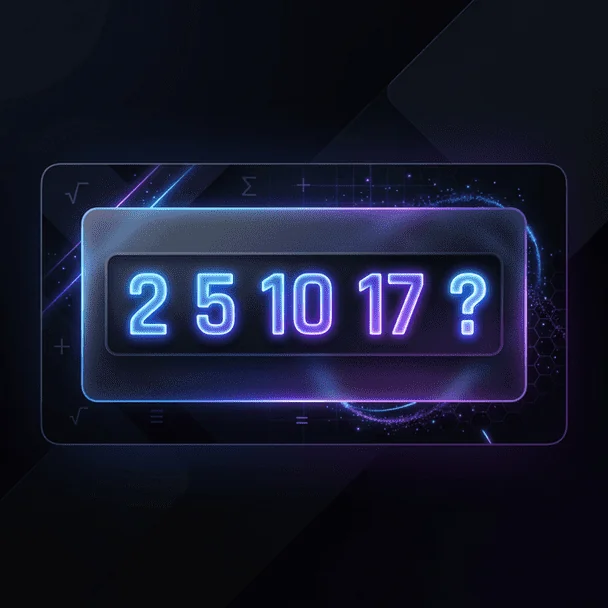
2, 5, 10, 17, 26...
Let's find the differences:
5 - 2 = 3
10 - 5 = 5
17 - 10 = 7
26 - 17 = 9
The gaps are 3, 5, 7, 9. The "gap of the gap" is always +2. This usually means the sequence involves squares (n²). Indeed, 2 is 1²+1, 5 is 2²+1, etc.
Level 3: The Fibonacci (The Nature Code)
This is the most famous pattern in nature, found in pinecones, sunflowers, and seashells.
1, 1, 2, 3, 5, 8, 13...
The Rule: Add the previous two numbers to get the next one.
1 + 1 = 2
1 + 2 = 3
2 + 3 = 5
💡 Pro Tip:
If you see a sequence that starts slow but grows moderately fast (but not as fast as multiplication), always check if it's a Fibonacci variation. For example: 2, 2, 4, 6, 10...
Level 4: Alternating Sequences
These are tricky because they look like chaos.
10, 2, 12, 4, 14, 6...
If the numbers go Up, Down, Up, Down... you are likely looking at two interleaved sequences.
- Sequence A (Odd positions): 10, 12, 14... (+2)
- Sequence B (Even positions): 2, 4, 6... (+2)
📋 Quick Reference Card
Constant gap between numbers
Multiplying by constant
Sum of previous two
Two interleaved patterns
The Golden Ratio and Fibonacci's Limit
The Fibonacci sequence—starting as 1, 1, 2, 3, 5, 8, 13—is more than an additive curiosity; it possesses a profound mathematical limit that connects it to the fundamental geometry of our universe. As the sequence progresses toward infinity, the ratio between consecutive terms—found by dividing a number by its predecessor—converges toward a unique irrational constant known as the Golden Ratio, phi (φ). This value is exactly (1 + √5) / 2, or approximately 1.618.
In the early stages, this ratio fluctuates: 3/2 is 1.5, and 5/3 is 1.66. However, variance diminishes rapidly as the numbers grow. By 144/89, the ratio is 1.6179, a striking proximity to phi. This convergence explains why Fibonacci patterns appear in the biological world, from the spirals of galaxies to the arrangement of sunflower seeds. Recognizing this limit allows enthusiasts to identify Fibonacci-based sequences even when they originate from non-traditional starting integers.
Polynomial Sequences and Finite Differences
When basic arithmetic or geometric checks fail, the Method of Finite Differences becomes indispensable. This technique involves taking the difference between consecutive terms to create a secondary sequence. If that sequence is not constant, the process is repeated until a constant value is reached. This analysis reveals the underlying polynomial degree of the pattern:
- First-Order Differences: If the first set of differences is constant, the sequence is linear, following the form f(n) = an + b.
- Second-Order Differences: If the second set of differences (the "gap of the gap") is constant, the sequence is quadratic, following the form f(n) = an² + bn + c.
- Third-Order Differences: Should the third level of subtraction reach constancy, the sequence is cubic, represented by a third-degree polynomial.
By identifying which level of difference remains constant, you can determine the underlying algebraic rule, allowing for the precise prediction of future terms. This method is the foundation of high-level IQ test patterns, where the logic is layered through multiple tiers. Mastering finite differences transforms seemingly impossible number sets into solvable algebraic equations.
The Neuroscience of Pattern Recognition
Engaging with number puzzles provides specialized "neuroplasticity training." Solving these problems activates the prefrontal cortex—the brain's command center for complex cognitive behavior and decision-making. The primary benefit lies in developing cognitive flexibility: the brain's ability to transition between conflicting rulesets and adapt to new information in real-time.
When tackling a sequence like 2, 3, 5, 9, 17..., the mind must evaluate multiple hypotheses: Is it addition? Is it multiplication minus one? This strengthens "working memory" —the mental scratchpad used to hold and manipulate information. Consistent stimulation fosters better inductive reasoning and deductive logic, highly transferable skills for analytical tasks and complex problem-solving. Research suggests these workouts help maintain synaptic density, protecting against age-related cognitive decline.
Conclusion
Number sequences are everywhere—from IQ tests and job interviews to daily puzzles like ours. The key is to approach them systematically: check the gaps, then the gap of the gaps, then special patterns like Fibonacci.
With practice, you'll start recognizing these patterns instantly. Ready to test your skills?

Frequently Asked Questions
What is the easiest way to solve a number sequence?
Start by finding the difference between consecutive numbers. If the difference is constant, it's arithmetic. If the ratio is constant, it's geometric. For harder patterns, find the "difference of the differences."
Why are number puzzles so common in logic tests?
Number puzzles test inductive reasoning and cognitive flexibility without relying on language skills. They are universal indicators of your ability to recognize patterns and apply deductive logic under pressure.
How do I recognize a Fibonacci mathematical sequence?
Look for a mathematical sequence where each number is the sum of the two preceding ones. The most famous example is 1, 1, 2, 3, 5, 8, but variations can start with any numbers, like 2, 2, 4, 6, 10.
Can practicing math puzzles improve my IQ score?
While IQ scores measure innate intelligence, practicing math puzzles provides neuroplasticity training. This improves your working memory and pattern recognition, which can boost your performance on standardized analytical tests.
Are daily brain games effective for adult cognitive health?
Yes. Research indicates that solving complex logic problems and daily brain games strengthens neural pathways. It's a workout for the prefrontal cortex, which is vital for complex decision-making and cognitive maintenance.
What is the most difficult pattern in numerical mind games?
Alternating and polynomial patterns are often considered the most difficult in numerical mind games. Alternating patterns interleave two separate sequences, while polynomial patterns require calculating multiple tiers of differences to find the constant gap.